

From Strategy to Execution: What Actually Changes Outcomes? | Fourth Strategies
GROWTH
Organizations invest significant time developing strategy. But the real challenge isn't the plan - it's building the capacity to make it real.
A strategy isn't an operating system.
A strategy establishes choices. Where will we compete? What will we prioritize? What opportunities will we pursue? What will we stop doing? Those decisions matter. But a strategy doesn't automatically create the organizational capability required to act on them.
The execution gap is often a capacity gap.
When execution stalls, organizations frequently respond by asking people to work harder. More meetings. More urgency. More project management. But if a team doesn't have the right systems, technology, processes, decision rights, skills, or bandwidth, greater effort has limits. An execution problem may actually be a strategy, systems, technology, or capacity problem.
What must become true?
One of the most useful questions leaders can ask after establishing a strategy is: “What must become true about our organization for this strategy to work?” This shifts the conversation from what we want to achieve to what the organization must become capable of doing.
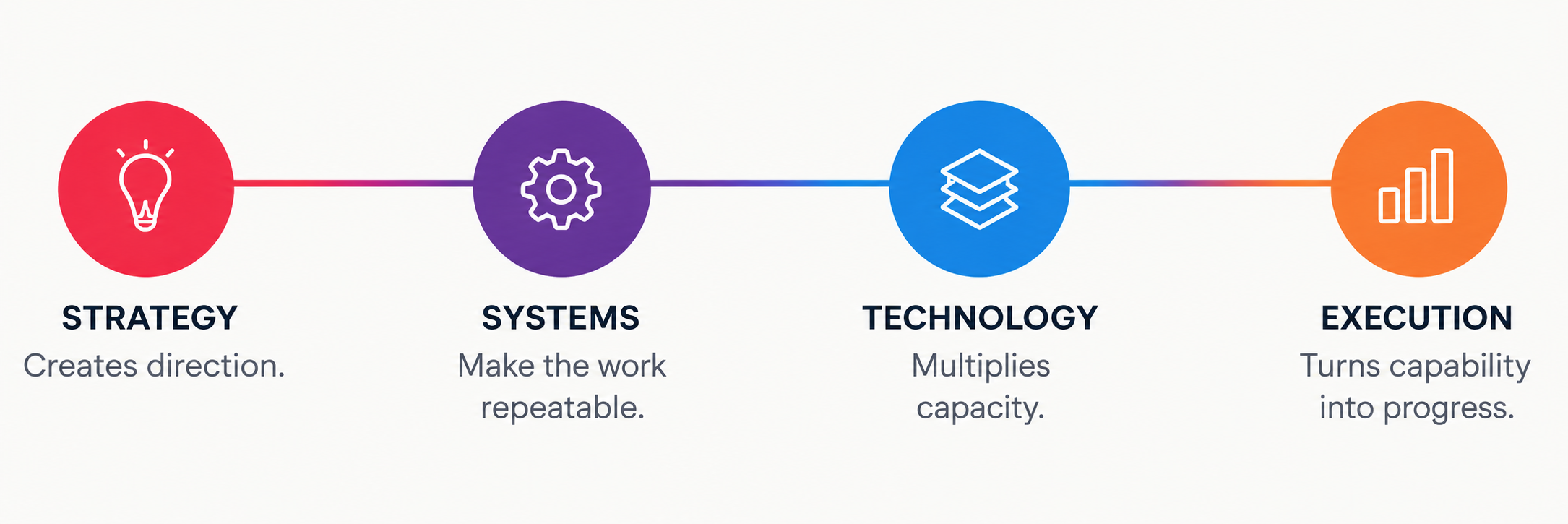
Four capabilities shape execution.
Growth happens when Strategy, Systems, Technology, and Execution work together. A weakness in one can constrain the others. Most challenges don't require equal attention in all four, but understanding how they interact is essential.
Execution should influence strategy.
Organizations often treat execution as something that happens after strategy. But execution realities should inform strategic decisions from the beginning. Understanding the distance between current capacity and required capacity is part of the strategy.
Build capacity deliberately.
Some capacity can be developed internally. Some can be enabled through technology. Some requires
redesigned systems, new talent, or partners. The key is to treat capacity as something that can be
designed, rather than assuming execution will somehow emerge after the plan is announced.
Measure progress differently.
Completing a project is useful. Building a capability is more valuable. The question isn't just “Did we
complete the initiative?” but “What can the organization do now that it couldn't do before?”
From plan to capability to outcome.
The path from strategy to results isn't just STRATEGY → EXECUTION. It's STRATEGY → REQUIRED
CAPACITY → EXECUTION → OUTCOME. That middle step is where many transformations succeed or fail.
“Strategy defines the destination. Capacity
determines whether you can get there.”
BUILD WHAT THE OUTCOME REQUIRES.
Fourth Strategies helps organizations turn strategic priorities into the systems, technology, and execution capacity required to move from intention to outcome.